DealBrief
Cited deal documents from private data
A platform for deal teams: turns private documents into grounded, cited teasers, IC memos, and CIMs — every figure traced to its source, built for speed without sacrificing rigor.
What DealBrief is
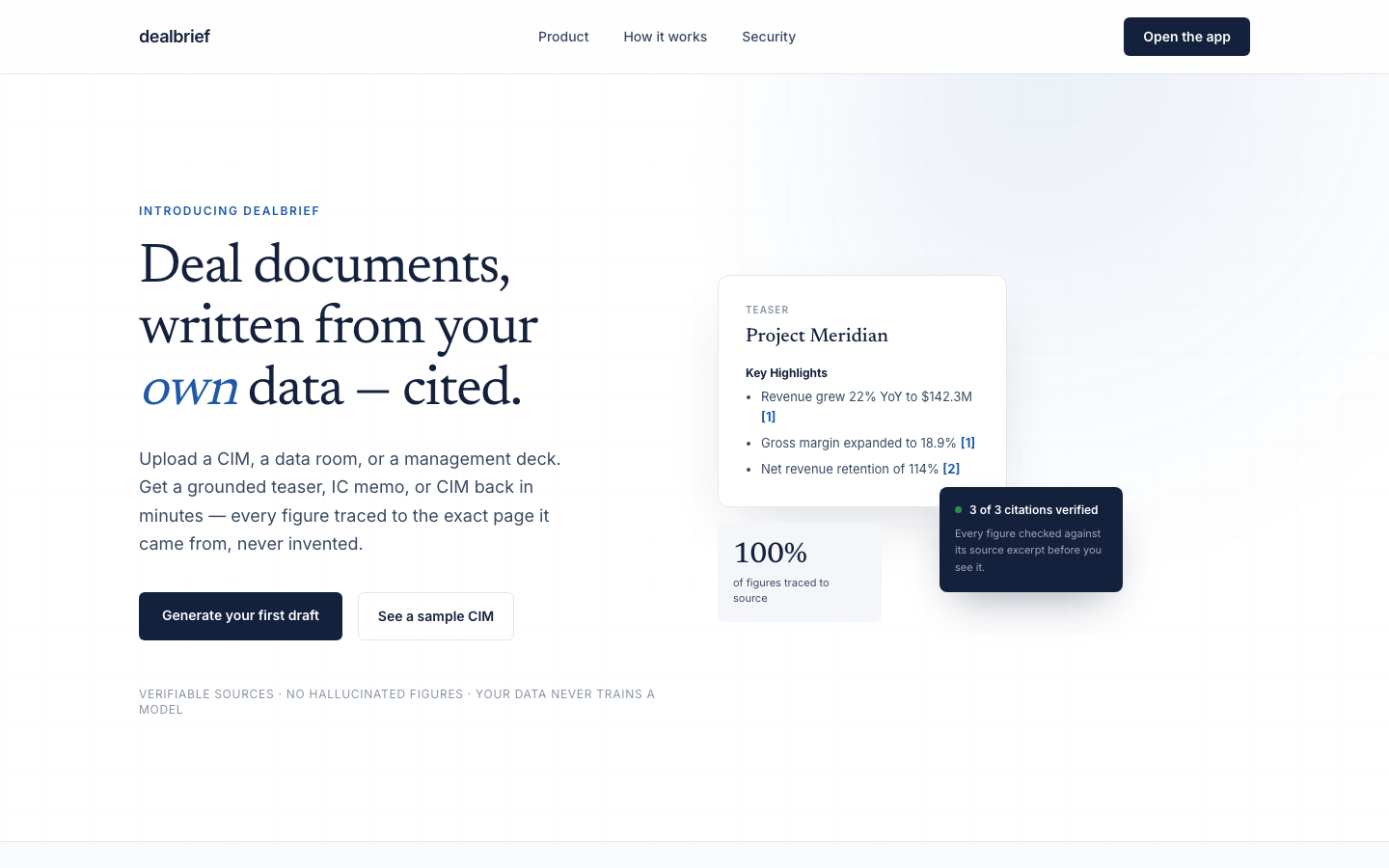
DealBrief turns private deal documents — a CIM, a data room, a management deck — into grounded, cited deal documents: teasers, IC memos, and CIMs, with every figure traced back to its source. Built for deal teams who need a fast, focused way to turn a stack of private documents into a specific deliverable, without sacrificing the one thing that actually matters: every number and claim traceable back to where it came from.
Why grounding is non-negotiable
Deal documents get scrutinized — an analyst, a committee, a counterparty will check a number against its source sooner or later. A tool that generates confident-sounding prose isn't actually useful if the numbers can't be trusted; it just moves the verification work downstream instead of removing it. Grounding isn't a feature layered on top of a faster drafting tool here — it's the constraint the rest of the product is designed around.
Three document types, one pipeline
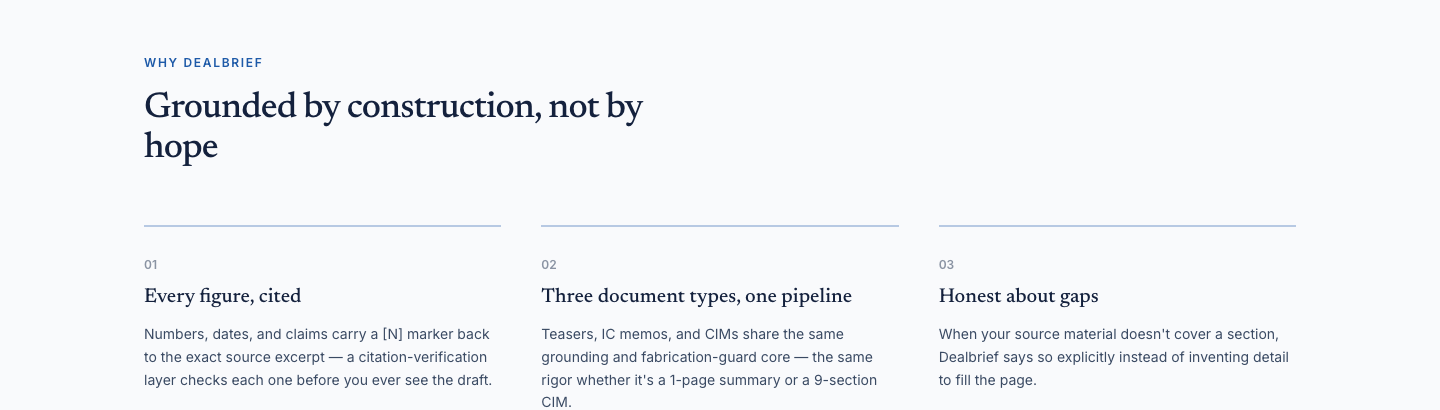
A teaser (a one-to-two page summary: company overview, key highlights, deal rationale, headline financials), an IC memo (a longer analytical memo, including a genuine key-risks-and-mitigants section and a recommendation), and a CIM (the longest, nine sections) all share the same grounding and fabrication-guard core — the same rigor whether it's a one-page summary or a nine-section document. Upload a document or point to a URL and it's parsed, chunked, and embedded automatically; pick a document type and the source materials; review the citation status per claim; export as PDF, Word, or Markdown.
Honest about gaps, not just about facts
Every number, date, and claim carries a citation marker back to the exact source excerpt, checked by a citation-verification layer before a draft is ever shown. When the source material doesn't cover a section, DealBrief says so explicitly instead of inventing detail to fill the page — true across all three document types, including the longest one, where there's the most pressure for the prose to fill a gap with something plausible-sounding instead of admitting it isn't there.
Where it stands
All three document types run end to end today — upload, generate, review, and export as PDF, Word, or Markdown. Access is controlled with a single API key per deployment, and documents are never used to train a model.