Auralis
AI music catalog search
A music catalog search engine that turns raw audio and sheet music into structured, searchable features — lyrics, melody, rhythm, key, instrumentation — so a catalog can be searched by how a song sounds, not just its tags.
What Auralis is
Auralis is a music catalog search engine. It turns raw audio, and sheet music, into structured, queryable musical features — lyrics, melody, rhythm, key, instrumentation — so a catalog can be searched by how a song actually sounds, not just what someone typed into a metadata field.
The problem with tag-based catalog search
Manually-tagged catalogs miss two kinds of query entirely. Exact musical properties — a note held for three beats, a specific tempo-and-key combination — usually aren't tagged at all, because no one sits down and annotates every song at that level of detail. And conceptual queries — "rhythm similar to bossa nova, no vocals" — can't be expressed as a fixed tag vocabulary; either the exact tag exists or the search comes up empty. This same pattern — combining multiple musical dimensions into one searchable index — is already validated commercially in sync licensing, where catalog owners report large jumps in search efficiency once auto-tagging and natural-language search replace manual metadata. Auralis takes the same idea further: audio and sheet music, exact filters and semantic search, in one system.
Two input paths, one index
Catalogs don't arrive in one format, so Auralis handles two:
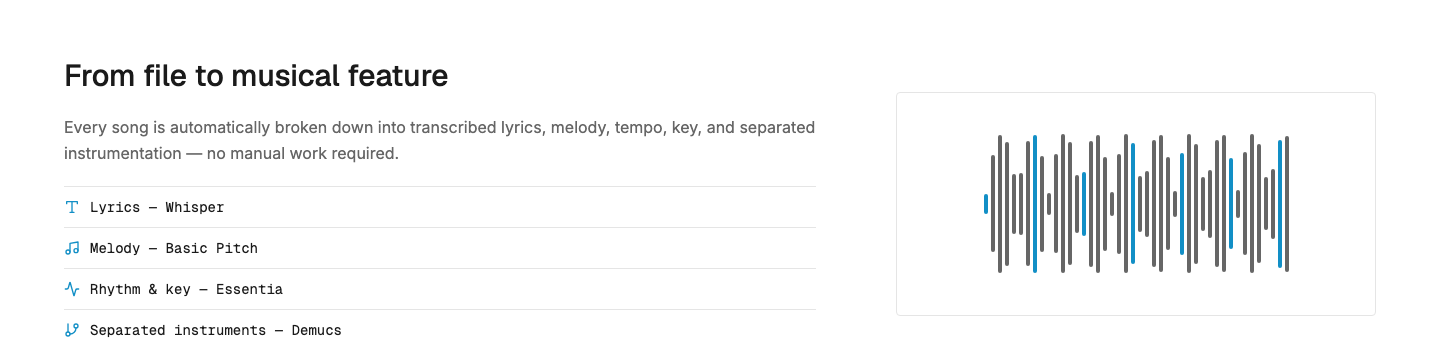
- Audio — a song file goes through source separation (isolating vocals, drums, bass, and other instruments), lyric transcription from the isolated vocal stem, melody extraction to MIDI, and tempo/key detection, plus a semantic audio embedding that captures the way a song sounds rather than just its metadata.
- Sheet music (MusicXML) — when the input is already a score, there's nothing to infer — the notation is structured data from the start. Note durations, time signature, key, and rhythmic patterns are parsed directly and stored as exact fractions (not decimals), so a query like "every song with a note held for three beats" never misses a match to a floating-point rounding error.
Exact filters and semantic search, same database
Not everything needs to be an embedding. A property that's already explicit in the data — a note duration, a key signature — is stored as structured metadata and queried with an exact filter: more precise and more explainable than an approximate similarity search for something that isn't actually approximate. Semantic search is reserved for genuinely fuzzy queries that can't be written as a filter — "a rhythm similar to this one," "sounds like X, no vocals." Both live in the same vector database, so today's exact-filter search and tomorrow's similarity search share one index instead of two systems that need to be kept in sync.
How songs get found
Upload a file, and Auralis extracts lyrics, melody, rhythm, key, and instrumentation automatically — no manual tagging step in between. Both the exact metadata and the semantic embedding get indexed immediately, so the catalog is searchable right away: by a specific musical property, or by describing what something sounds like in plain language.